
Tips for Better Writing
This month we’re talking about writing. Writing is an important ingredient to your business.
Good writing forges a path between you and the people you’re trying to reach. It encourages interactions between you and your audience – on your website, social media accounts, pamphlets, blogs, even video content.
Because of this, writing plays a formative role in your business or organisation.
Writing is Hard
Over the years, in various professional environments, people have said to me, ‘writing is hard’. They’re not wrong. It can be difficult to get your message just right.
Because of the perceived difficulty, people tend to respond in a few ways:
They decide not to communicate at all
They rush their writing
They use Artificial Intelligence (AI) to do their writing
Why is this a problem?
Well, it may not be. It depends on the nature of your business or organisation and what you’re trying to achieve. It can be a problem for businesses and organisations, though. Here’s why.
Not communicating
If you avoid communicating with your audience, they probably won’t know what you do. You’ll fall off their radar. They’ll forget you exist. Or, they won’t know that you exist in the first place.
Not communicating is probably not a good strategy unless you have recurring contracts to fall back on!
It’s understandable that you want to stay quiet if you don’t know quite what to say, or how to say it. In most cases though, it’s better to say something.
Rushed writing
There’s nothing wrong with writing something that isn’t perfect. Give me a piece of writing with a spelling error any day, over something written by AI. It’s immediately more authentic. Even if it’s rough around the edges it feels human, relatable, even charming.
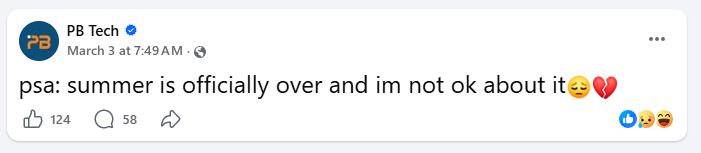
Some businesses lean into a casual approach to writing. Here’s a relatively recent post from PB Tech.
Click image for source
This post got a lot of engagement compared with their more standard posts. Is it technically well-written? No. Is it about technology? No. But it was obviously relatable!
This PB Tech post worked because people had a response to it. People wanted to comment on it and share their opinion. It probably placed well organically. This means it would have popped up in people’s feeds by itself – even if they weren’t following PB Tech. Indirectly, it probably helped with sales, which I assume is their goal.
Less positively, rushed writing can be a problem. It can be sloppy and unfocussed. Write something too off-the-cuff, and people might not resonate with it. You may appear ‘unprofessional’. It may even actively deter people from purchasing a product. You risk alienating your audience.
Use AI
AI has become a go-to supportive tool for writing. Sure, it can be useful if you’re stuck for ideas, don’t know where to begin, or find it difficult to put things into words. In theory, using AI to craft a message works. There are risks, however.
Two impactful risks relate to authenticity and sameness. To pick on LinkedIn for a moment, many current posts appear to me to be AI-authored. There’s a very similar tone and style to everything.
Content begins to feel samey. This lessens the perceived authenticity and uniqueness of what a person has to say. Everyone kind of blends together.
The content itself might be quality, but audiences are unlikely to notice or care.
People stop reading things or glaze over content. Your message becomes ineffective.
Tips for better writing
Luckily there are some straightforward ways to make writing easier, which will also help your writing be more impactful. Here they are.
Prep work
Before you even begin, think about the following questions:
Why are you communicating?
What’s your core message?
Who’s your audience?
Doing the writing
Draft ideas
Keep things simple
Delete and re-write
Edit anything written by AI

Case Study
To help ground these tips in reality, let’s go through my process of drafting this article.
Prep work
Before beginning, I asked myself, ‘why are you writing an article?’. The first and least satisfactory answer was ‘we need to do a monthly blog about our work’. That wasn’t particularly motivating!
The second answer was ‘I only want to write this if I can share some expertise and give people something tangible to take away’. That was a lot more motivating and addressed why I’m communicating.
To risk cliché, I’m passionate about writing. That’s why I chose it as this article’s topic. I like being solution-focussed so my core message was around identifying some common challenges with writing, and how to do something about them.
As for my audience, I’m writing for people who might be interested in our work at Kumeū Media. They’re either in a similar profession or they’re someone who might like help from us.
This informed my writing style, and how I explained things.
Writing
The drafting phase was me throwing a bunch of thoughts onto the page. I used key words or bullet points. From there I began expanding them into paragraphs and thinking about a logical order and structure.
If you’re writing a social media post, this may begin with a keyword, and end up being a sentence or two once it’s complete.
Throughout writing, I’ve asked myself things like,
What’s my point here?
How easy is this to understand?
Can I use fewer words?
Can I make this clearer?
Can I write this more informally?
Can I make this more specific?
As the article grew, I’ve gone back and re-written things. There were two motives: make things simple and delete everything that’s not needed.
After editing and proofreading it a few times, I now feel pretty satisfied with what I’ve written. It takes patience and time, but this is much better than my first draft and initial ideas!
The takeaways
There are a few things we want to leave you with.
Communicate imperfectly with your audience.
Take your time with writing
Be clear about your message
If you use AI, check and edit it to match your communication style, brand, or messaging framework
Use our tips if you need a template
If you want more hands-on or focussed support with your writing or projects, feel free to reach out to us. We’re keen to help!
